
Four Texas Release Dates
| Date | What it means |
|---|---|
| Parole eligibility | The first statutory point at which a case may be considered. It is neither approval nor a release appointment. |
| Projected Release Date | TDCJ Classification and Records’ estimate if the person is not paroled sooner, calculated under offense-date and eligibility rules. |
| Scheduled Release | A date and location that may appear after BPP approval, certificate preparation, and audit. It remains changeable. |
| Actual release or discharge | The historical event confirmed in the custodian’s record after it occurs. |
A pretrial detainee at Comal County Jail does not have a sentence-based projected date. Bond, dismissal, a court order, transfer, or later sentencing may end or change that custody. Article 17.033’s 24- and 72-hour probable-cause safeguards for certain warrantless arrests are not sentence credits or a public release calendar.
Locate a Comal Inmate Release Date
- Identify the custodian. Determine whether the person is in Comal County Jail, a TDCJ prison or state jail, federal custody, or another county. A Comal court case alone does not establish present custody.
- For current TDCJ custody, search official records. Open the TDCJ Inmate Search. Use the TDCJ or SID number when possible, or the exact last name with at least a first initial. Compare identifiers, offense, and location.
- Read the label precisely. Record whether the result says projected, scheduled, eligibility, or review. Do not rewrite one as another.
- For county custody, obtain the legal and operational records. Search Comal Judicial Records for the judgment and Jail Records or Jail Bond Records for the custody episode. If needed, request the jail’s release calculation or booking-out record.
- For a former TDCJ prisoner, use the historical channel. Email pia@tdcj.texas.gov with the full name and seven-digit TDCJ number. If unknown, provide exact birth date or approximate age and county of conviction. Ask for incarceration history, actual release/discharge date, release type, and public supervision information.
- Confirm after the event. A notification or scheduled date can prompt the check; the agency’s actual release record is the evidence.
The TDCJ public search includes only people currently incarcerated in a TDCJ facility. Its fields include last and first name, TDCJ number, SID number, gender, and race. Data are updated on working days and are at least 24 hours old. A former prisoner’s absence is therefore expected behavior, not an affirmative “Released” result. TDCJ custody also does not cover a routine Comal bond-out.
How TDCJ Defines Projection
The TDCJ definitions page identifies projected release as the date Classification and Records estimates if parole does not occur sooner:
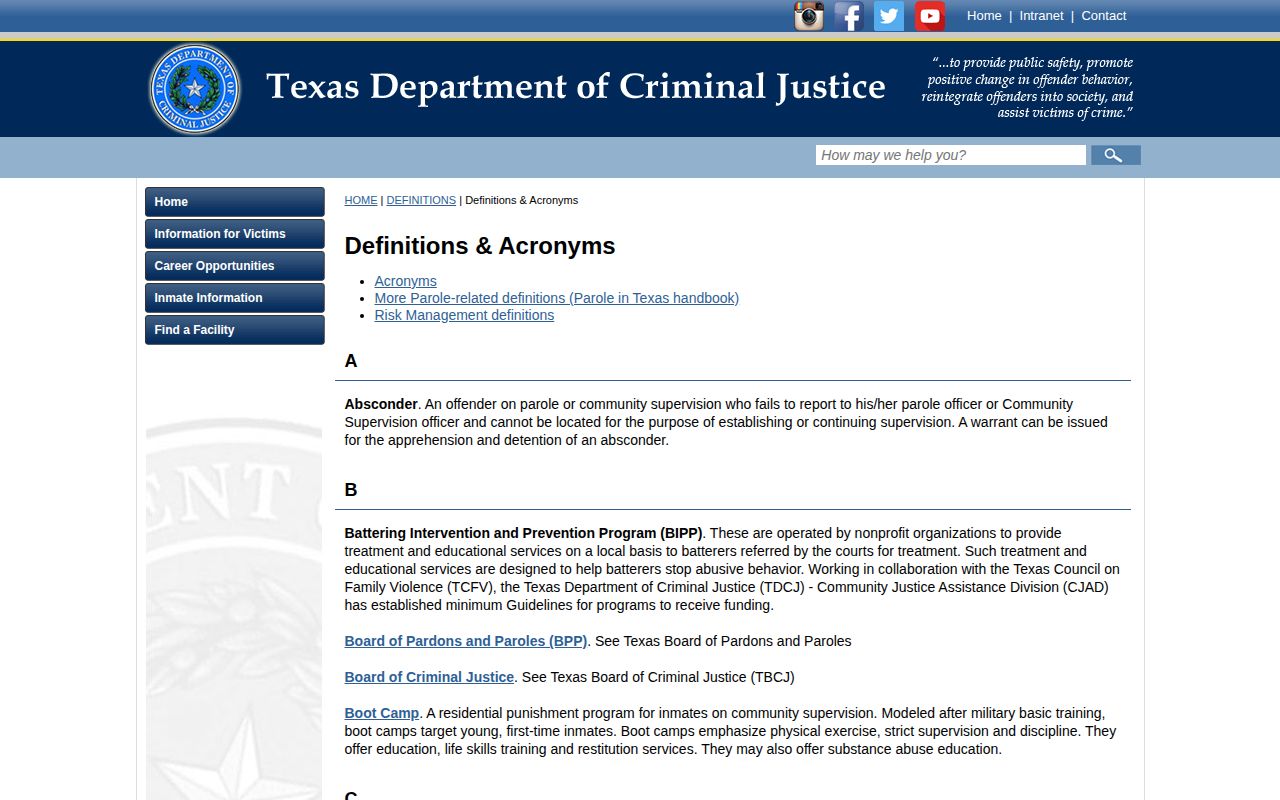
The official wording matters because the field combines an administrative calculation with assumptions about the person’s current record. It is not the same as actual discharge. After BPP approval and audit, a detail page may add a scheduled date and release location. TDCJ says the audit and calculation commonly take about 14 to 21 business days and warns that a scheduled date can change at any time.
Texas Good-Conduct Time Rules
Government Code Chapter 498 controls TDCJ good-conduct time. Section 498.003 says the credit affects eligibility for parole or mandatory supervision; it does not reduce the sentence term itself. It is a privilege rather than a right and depends on classification and participation. Subject to the full statute, the listed rates include 20 days per 30 days actually served for trusty and Class I status, with specified additional possibilities; 10 days per 30 for Class II; and none for Class III. Subsection (d) permits as many as 15 additional days per 30 for diligent participation in qualifying work, agricultural, educational, or vocational programs. Section 498.004 permits forfeiture.
For mandatory-supervision-eligible offenses before September 1, 1996, TDCJ describes the projected formula as calendar time plus good time equaling the sentence. For eligible offenses on or after that date, the same sum can reach the sentence, but BPP must approve discretionary mandatory supervision. A denial may recalculate the projection to maximum expiration; later approval may move it earlier. For an ineligible person, projection is generally the maximum expiration or discharge date based on flat time.
Texas has no blanket rule that every person serves 85 percent. Under Government Code Section 508.145, the ordinary parole formula generally reaches eligibility when calendar time plus good time equals one-fourth of the sentence or 15 years, whichever is less, subject to exceptions. For the Article 42A.054 category and certain deadly-weapon findings, subsection (d) generally requires calendar time without good-time credit equal to one-half the sentence or 30 years, whichever is less, and at least two years. Section 508.149 excludes specified people and offenses from mandatory supervision. Offense date, judgment, enhancements, consecutive sentences, jail credits, and other provisions can change the result, so a one-size calculator is unsafe.
What Moves the Calculated Date?
| Factor | Possible effect |
|---|---|
| Classification and participation | Changes the rate at which eligible good-conduct credits accrue. |
| Discipline | Credits may be forfeited, and recalculation can move a projected date. |
| Offense date or corrected judgment | Determines which eligibility law applies and can change the base calculation. |
| Jail credit or consecutive sentences | Changes credited flat time or how sentence periods are combined. |
| BPP vote | Approval may move release earlier; denial can move projection toward maximum expiration. |
| Required program or release plan | A favorable vote may still await program completion and approved placement. |
| Detainer or hold | May change the release destination or prevent community release. |
| New information or rescission | Can withdraw approval and trigger another calculation. |
A transfer is not necessarily freedom in the community. If Comal’s record names a receiving authority, continue with that agency. Likewise, “scheduled release location” identifies planned processing and does not by itself establish that release occurred there.
Comal County Sentences Need Records
A county-jail sentence follows the signed judgment, credit for time served, applicable county good-conduct law or policy, and any holds. The research found no official Comal online calculator or published blanket local credit rate. Do not import a TDCJ formula into a county sentence.
Use Criminal Case Records to obtain the judgment and compare it with the jail episode. The District Clerk’s Records and Resources page routes copy requests. If the calculation or actual booking-out detail is missing, submit a written request through the Criminal/Jail Records Division, the county’s online form, an in-person request at 3000 IH 35 South, or fax 830-608-0147. Identify the booked name, approximate incarceration dates, booking number if known, and request the actual release date and time, disposition, and receiving agency if transferred. Phone 830-620-3412 can clarify routing.
A bond order explains legal authority to leave pending proceedings, but the jail record supplies the operational time. A sentence entry explains confinement and credit, but only the later release record confirms the actual event.
Confirm the Final Release Event
For a pending county event, VINELink Release Check explains the current IVSS-Counties alert route. The portal may alert to booking, release, transfer, or court events, but it warns that people no longer in custody may disappear from search. Absence is not proof. For TDCJ custody, use the separate TDCJ IVSS. A notification is a timely clue, not a certified historical record.
TDCJ telephone routes also depend on stage. General Huntsville information uses 936-295-6371 or 800-535-0283; without a TDCJ or SID number, the caller needs exact date of birth. Pre-vote status uses 844-512-0461. After approval or for release and supervision status, Parole Division uses 512-406-5202. These lines are generally staffed weekdays from 8 a.m. to 5 p.m. When timing is disputed or historical, request the written record.
Build a Reliable Date Record
Write down the source, retrieval date, exact label, TDCJ or booking number, and location shown with every date. Then preserve the later confirmation. This simple chain prevents an old projection from being presented as an actual release. It also separates departure from one building from release to the community. A Comal record may instead show transfer to TDCJ, return to another county, or movement under federal authority.
When records conflict, compare their functions. The criminal judgment controls the sentence and credit ordered by the court. TDCJ Classification and Records calculates the state projection. BPP decides parole or discretionary mandatory supervision. The jail documents county intake and booking-out. IVSS reports informational events. A newer official calculation can supersede an older screenshot without making the earlier display fraudulent; it may reflect discipline, a corrected judgment, a hold, or another documented change.
Ask a narrow question when requesting correction or confirmation: identify the person and custody episode, quote the conflicting labels and dates, and ask which date is current and whether an actual release or transfer has occurred. Avoid requesting unrelated personal information. The resulting written response is more useful than trying to infer a date from roster absence.