
Which Supervision System Applies?
A person released from Comal County Jail is not automatically on parole or probation. Release on bond means the criminal case remains pending unless a later court order says otherwise. Completion of county time may end confinement without creating state parole. A transfer to TDCJ means the county jail was only one stage in the custody chain.
| Record question | Responsible source |
|---|---|
| Was community supervision imposed by a Comal court? | The criminal case docket, signed judgment, and Caldwell, Comal and Hays CSCD |
| Did BPP approve parole or mandatory supervision? | TDCJ inmate record and Texas Board of Pardons and Paroles review information |
| Who supervises a released TDCJ person in Comal County? | TDCJ Parole Division, usually the Seguin District Parole Office |
| When did county custody actually end? | Comal Jail Records, Jail Bond Records, or a written jail-record response |
Start with the last custodian and the legal document. A name disappearing from a live roster does not establish release to the community or supervision status.
Comal Community Supervision
The Caldwell, Comal and Hays Community Supervision and Corrections Department serves the criminal district courts and county courts at law in all three counties. The judge determines the term, costs, fines, restitution, and conditions. CSCD administers those conditions. If a violation is reported, court personnel may hold a hearing; the judge may continue or modify supervision, revoke it, or impose a county-jail or TDCJ sentence.
The Comal adult-probation listing gives 160 East Bridge Street, New Braunfels, TX 78130; 830-221-1160; fax 830-608-2029. Posted hours are Monday through Friday, 8 a.m. to 5 p.m., with Tuesday evening availability until 7 by appointment. The county page parenthetically labels the telephone number “Canyon Lake Office” even though it appears with the New Braunfels address. Because that label is unresolved, confirm the office and appointment routing when calling.
There is no public statewide roster of every probationer. Verify community supervision through the sentencing case and an authorized CSCD contact. The Comal Judicial Record Search can provide the case trail; match the case number, charge, and signed judgment instead of relying on name alone. A jail release entry answers when custody ended, while the judgment explains whether probation was ordered.
Texas Parole Roles
The Texas Board of Pardons and Paroles makes parole release, condition, and revocation decisions. TDCJ Parole Division identifies and processes eligible cases, prepares release work, and supervises people in the community. It does not cast the release vote. Texas also distinguishes parole, mandatory supervision, and discretionary mandatory supervision; a generic “released” label should not be used to guess which applies.
Use the TDCJ Inmate Search while a person remains incarcerated. It accepts a TDCJ number, SID number, or exact last name with at least a first initial, and its public data are updated on working days and at least 24 hours old. The search covers current TDCJ custody, not an ordinary Comal County bond-out and not a durable archive of former prisoners. For historical incarceration or discharge information, email pia@tdcj.texas.gov with the full name and seven-digit TDCJ number. If unknown, include exact date of birth or approximate age and county of conviction, then request the actual release/discharge date, type, and public supervision information.
How Texas Parole Review Works
Texas parole release review is normally a file review, not an open courtroom hearing with a person-by-person public calendar. TDCJ generally identifies an initial-review case about six months before eligibility and a subsequent case about four months before the next review. An institutional parole officer prepares the case summary, and a three-member panel votes sequentially. Two matching votes decide the case. A personal interview is discretionary, and Government Code Section 551.124 does not require an open meeting for BPP inmate interviews or counseling.
The official BPP review explanation shows the cadence and file-review stages:
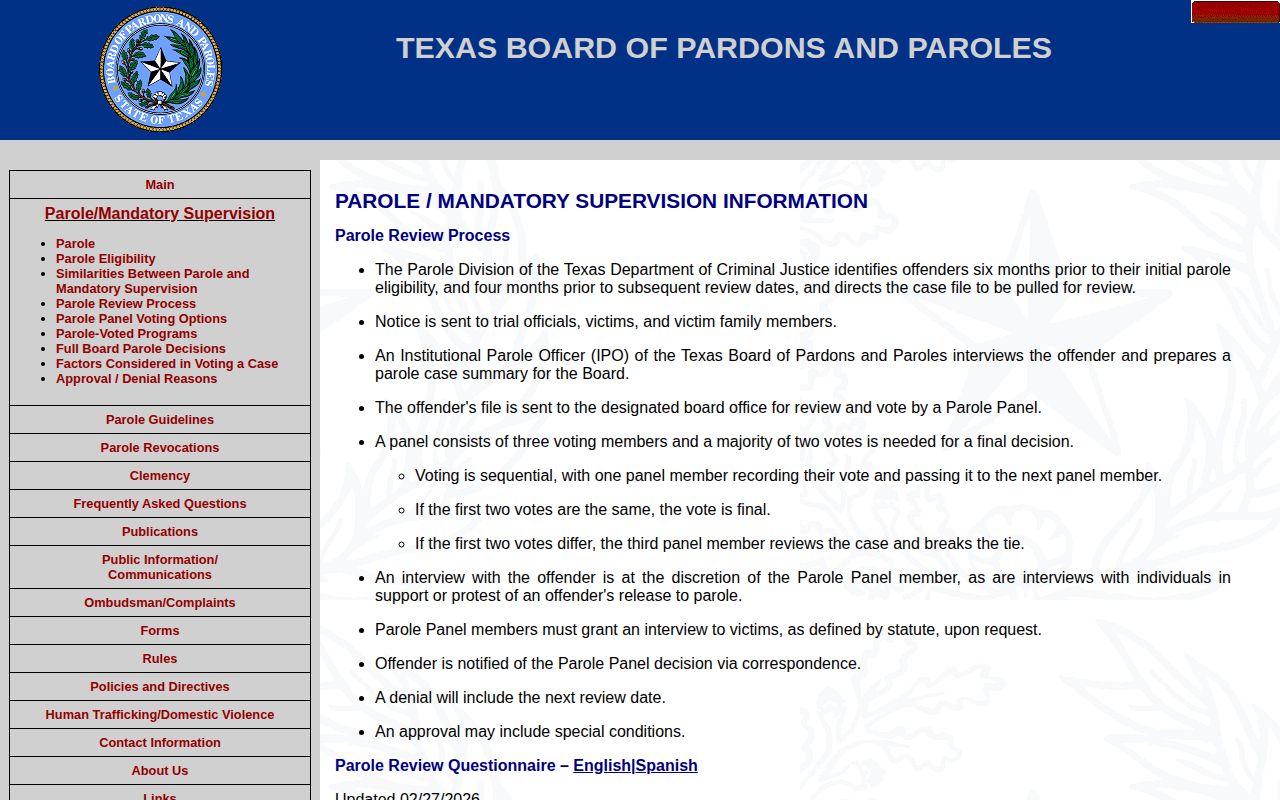
The process image is a guide to review timing, not a hearing date or release appointment for a named person.
Check current results in the TDCJ record’s Parole Review Information or call 844-512-0461 with the name, TDCJ number, and date of birth. Codes carry conditions. FI-1 indicates an eligible release; FI-2 specifies a future month and year; FI-3R, FI-4R, and related codes can require a program. NR sets a later review, SA means serve all, and DMS denies mandatory supervision under the applicable review treatment. Read the official vote-code definitions before describing an outcome.
Eligibility Is Not Release
Government Code Section 508.145 supplies the principal parole formulas and exceptions. The ordinary formula commonly reaches eligibility when calendar time plus good time equals one-fourth of the sentence or 15 years, whichever is less. For Article 42A.054 offenses and certain deadly-weapon findings, Section 508.145(d) generally requires actual calendar time equal to one-half of the sentence or 30 years, whichever is less, without good-time credit and with at least two years served. Other offenses or enhancements can change or eliminate eligibility.
Texas does not have a blanket rule that every prisoner serves 85 percent. Eligibility only permits consideration. A favorable vote can still require a release plan, program completion, certificate preparation, audit, and detainer resolution. New information can cause withdrawal or rescission. TDCJ says its scheduled-release calculation commonly takes 14 to 21 business days after approval processing and may change even on release day. Confirm the actual event afterward through TDCJ history rather than treating eligibility, approval, or a projected date as discharge.
Seguin Handles State Parole
Comal County maps to the Seguin District Parole Office in Region IV. The published office is 11010 FM 725, Seguin, TX 78155; 830-303-4906; fax 830-372-4945.
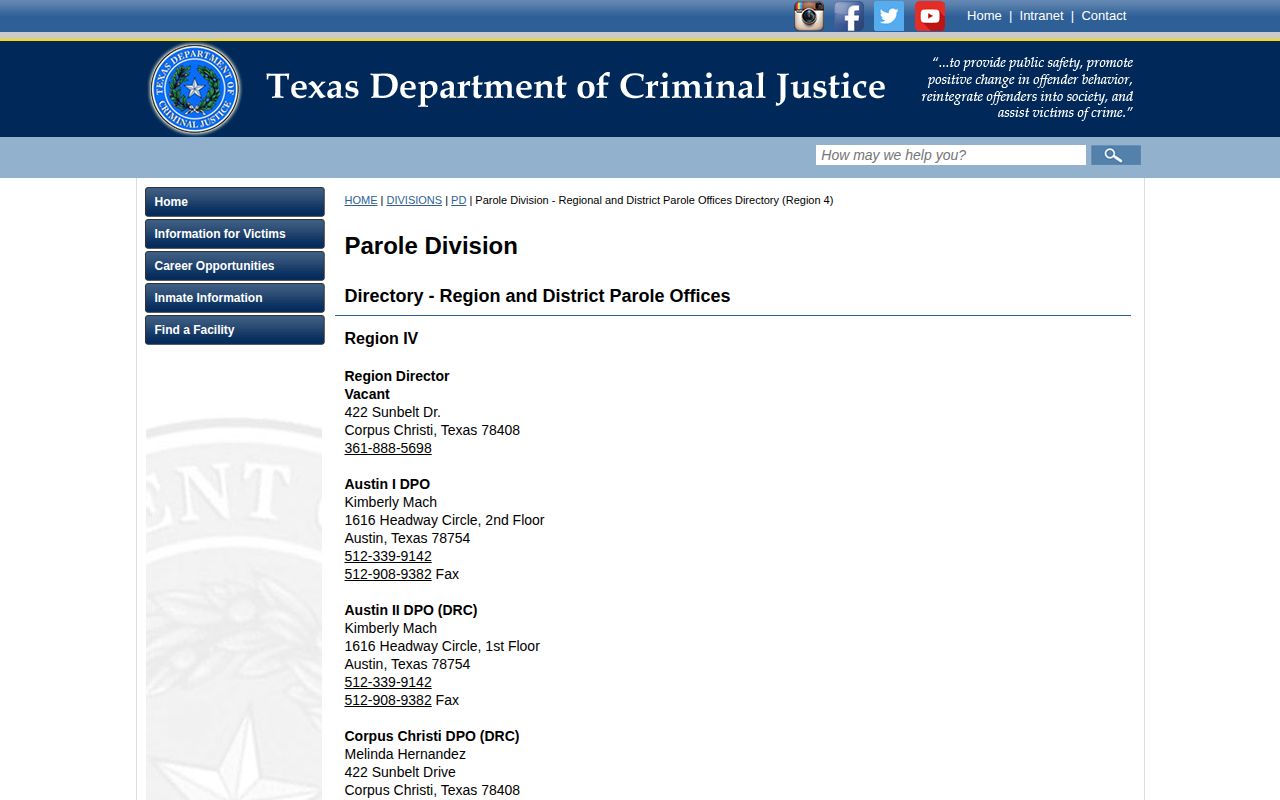
This office listing is the local routing evidence for TDCJ parole and mandatory supervision in Comal County; it is separate from the East Bridge Street probation office.
First obtain the correct TDCJ or SID number and the release or approval status. The Parole Division post-approval and release-status line is 512-406-5202. Its central office is at 8610 Shoal Creek Boulevard, Austin, with 512-406-5250. Do not ask county probation staff to verify state parole.
Verify Warrant Claims Carefully
The TDCJ Parole Division Command Center operates around the clock and enters, changes, and withdraws parole warrants in law-enforcement databases after violation reports and alerts. Its public page describes the function but is not a general name-searchable absconder list. The published warrant contact is 512-406-5398. A missed report or rumor must not be converted into a statement that an active warrant exists. Confirm with the responsible authority. The public sex-offender absconder search applies only to that special registration category and cannot stand in for a general parole check.
When a status is uncertain, preserve the distinction between an allegation, a reported violation, a warrant entry, and a judicial or board outcome. Each is a different event. Public court records may document a probation motion or hearing, while the state parole authority controls its warrant information. A news report, social post, or registry absence cannot replace either official channel.
Comal Property Deadlines After Release
Post-release tasks do not end with supervision. Comal publishes unusually specific property rules through its Inmate Commissary and Property page. Personal property left behind must be collected within 30 days. Commissary delivered at release must be collected within 72 hours, and the county states that there is no commissary refund on release. A person transferred to TDCJ, a state jail, or another custodial setting must identify a specific collector by name and telephone number. Property left beyond the posted periods is handled under the county’s abandoned-property rules.
These deadlines are their own administrative issue. They neither prove parole nor change a supervision condition. Use the county page for collection requirements, the sentencing court and CSCD for probation, and the Seguin office or TDCJ for state parole.